


Buffalo, N.Y. (WBEN) - As the United States celebrates 250 years of independence in 2026, WBEN is taking a look back on Buffalo and Western New York's role in the history of the country.
Mark Twain, the pen name used by Samuel Clemens, is widely regarded as one of the greatest American authors in history, with two of his best novels being The Adventures of Tom Sawyer (1876) and its sequel The Adventures of Huckleberry Finn (1884).
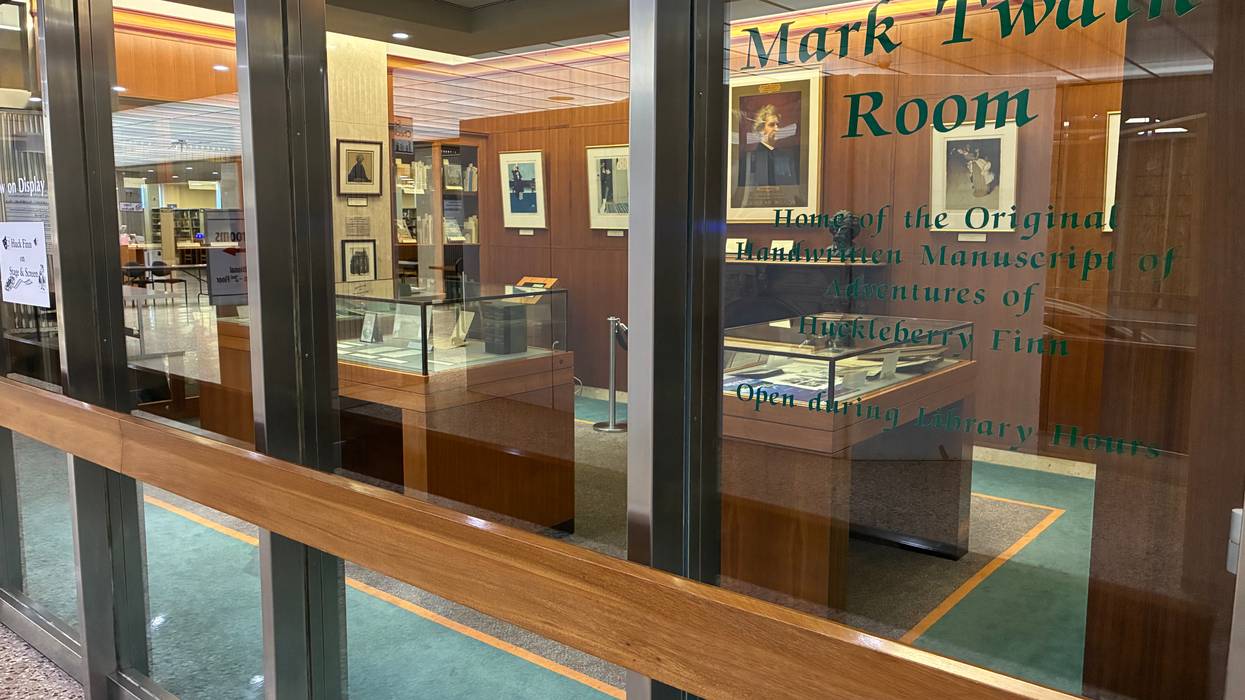
Some Western New Yorkers may not know this tidbit, not only did Twain live in Buffalo - albeit briefly - but the complete handwritten manuscript of The Adventures of Huckleberry Finn is preserved and displayed at the Buffalo and Erie County Public Library in Lafayette Square.
Twain lived in Buffalo from 1869 until 1871, and served as an impactful turning point in his personal life, as well as professional life.
"When Mark Twain came to Buffalo, he was able to start his young married life, but also was able to be a journalist writing for the Buffalo Express for that time," said Heather Gring, rare book curator at the Buffalo and Erie County Public Library. "Twain is in Buffalo in the late 1860s, early 1870s, and so he is building up a career as a journalist. I think it was partially this time as well that helped him realize he didn't want to be a newspaper man as much as he wanted to be a writer and an author, and I think that that really helped him figure out what trajectory he wanted to take. And aren't we so lucky for that still today?"
While in Buffalo with his new wife, Olivia, they gave birth to their first-born child, a son named Langdon, but she becomes dangerously ill after giving birth to him prematurely. Their son passed away in 1872 after the couple moved out of Buffalo and back to Elmira, N.Y.
Even though his time in Buffalo was not the happiest of his life, Gring feels it was very impactful in helping him to understand the scope of what he wanted to do as a writer in America.
"I think, really, the proof is in the pudding - that's a joke on Pudd'nhead Wilson that we have on display - but the fact that we still know who Twain is over 120 years later, that we still celebrate him and speak of his name, works of art are still made in honor of him, it is a sign that he continues to resonate long beyond his lifespan," Gring said with WBEN. "I think he truly, as an incredibly witty and succinct and a charismatic writer, really helped people look at things that were far too uncomfortable to approach in a lot of spheres. And we do need that sort of critical analysis, especially in reflecting on our own culture."
Gring says, perhaps, the greatest gift Twain left to Buffalo, even though it was a city that dealt him personal tragedy, is the artifact still on display in the Mark Twain Room at the library.
"In the 1880s, Twain was approached by a curator of the Buffalo Library named James Fraser Gluck, who reached out and said, 'We're building up a collection of notable people connected with Buffalo. We would love for you to donate something to this collection.' And Twain directly sent Part II of the handwritten manuscript of Huck Finn to be included in this collection," Gring recalled.
While Part I of the handwritten manuscript is also in possession of the Buffalo and Erie County Public Library, it took a while before it finally made its final stop in Western New York.
"Many years later, the printer reached out to Gluck again and said, 'We found Part I, here you go.' And for reasons we still don't completely understand, Part I remained at James Fraser Gluck's home for many years, even though he had donated Part II already to the library. We think he wanted to rebind it or something like that and never got around to it," Gring explained. "He passed away unexpectedly, and his widow was not aware that Part I of Huck Finn was in the bottom of a steamer trunk that she packed up and moved the whole family out to California. She lived out the rest of her days, never the wiser that she was in possession of Part I.
"Many, many years later in the late 1980s, a family descendant was going through the family attic and discovered Part I of Huck Finn in the bottom of the steamer trunk. And it was really because of the advocacy of my predecessor, the rare book curator named Mr. William Loos, [he] was so tapped into the National Twain Network that he got advance notice that it was coming to auction, and was able to make a successful bid that we had a claim to it. And it was settled out of court, everyone was handsomely compensated, but the most important thing is if not for Mr. Loos being so tied into the National Twain Network, this opportunity maybe would have completely gone past. He was able to advocate and build an actual legal case that showed that Part I had always been intended to come to the Buffalo Library. And because of him, that is why the Twain manuscript was reunited in the early 1990s."
That same steamer trunk is currently on display in the Mark Twain Room with another piece from Twain's old home that was located at 472 Delaware Avenue. That location was destroyed by a fire in the 1960s.
"What we do have in here is the original mantelpiece from Twain's home when he was a young married man here in Buffalo," Gring explained. "The building that they lived in on Delaware Avenue, it's called a semi-mansion, but it is truly quite a mansion that they lived in. The building has now been destroyed, but before that happened, the mantle was preserved and is now on permanent display here in the Mark Twain Room at Central Library."
The Mark Twain Room today was originally the old smoking room at the Buffalo and Erie County Public Library in the 1960s, which Gring feels Twain would have loved, having been known to have a cigar or a pipe on many occasions. The materials in the Mark Twain Room is always on display anytime the Central Library is open, and there's a broad range of objects for viewing.
"We do not collect everything that Twain ever made, but our one focus is on the collection of Huckleberry Finn publications," Gring noted. "We have almost every edition of The Adventures of Huckleberry Finn that was published. We also have the text in all sorts of different languages, we try to collect every language publication we can find. So over time, what we've really amassed is a collection that shows how continuously important, specifically this text, has been to our American understanding."
In the spirit of America 250, Gring feels it's important to highlight the impact of The Adventures of Huckleberry Finn, which she calls an incredibly important work of American literature.
"It's very important to us here at the library we are adamantly against book bans, and there's no better example of that than Huckleberry Finn," she said. "Huckleberry Finn is in the top-five books that have faced book bans in American history, and there's a lot of good reasons for it, but there's also a lot of nuance to understand the history of this text. Everybody has wanted to ban Huck Finn."
Among the groups wanting to ban this book was the NAACP due to how often it used racial slurs in the text.
"And yet the text itself was lifting up a mirror to American society at the time. And what are we really upset about, the words in writing or the culture that was saying it? That is really what Twain is asking us to look at, and that is what Twain has always asked us to look at in many of his works," Gring said. "He lifts up a mirror to American society, and all sorts of other inequities that we see in the world, and makes us really look at it."
Another notable group of people who tried to ban the novel was a lot of Southern religious groups.
"Historically, it was really dangerous that this book made a White boy speak in the same vernacular text as an enslaved Black man. That was dangerous at that time, and that's what Twain was really making us look at was this distinction between both race and class," Gring explained. "And yes, maybe we have race indifference, but class is often in unity. If we're not looking at that, we're not really realizing who stands in solidarity with us. And, of course, Huck Finn is a text both about where solidarity stands and where it falls apart, and I think that is a very important thing for us to continue to reflect on in the racially charged times that we still find ourselves in today."
The Buffalo and Erie County Public Library offers a digitalized, page-by-page version of the original The Adventures of Huckleberry Finn on its website.
"Our library system of 37 different branches has a wide range of text by Twain. So if you really want to learn more about what he wrote, the scope of all of his writings, you can really look in our library catalog and see the over 3 million books we have in this building alone," Gring noted.