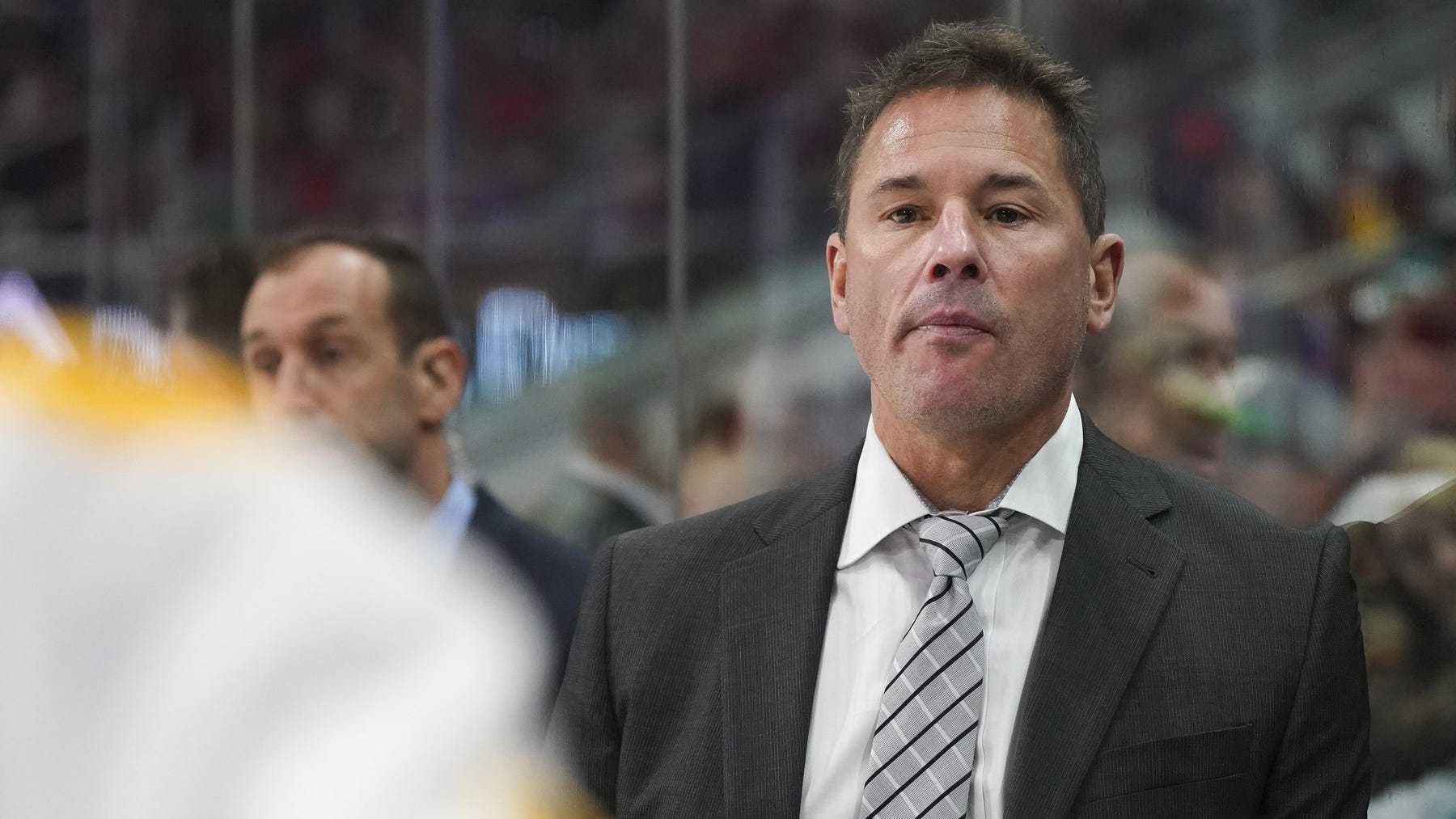


One of the criticisms of Bruce Cassidy that has surfaced since his firing on Monday is that he was too tough on young players.
Team president Cam Neely said himself after the season that there needed to be a change in the handling of young players, who he said were "afraid to make mistakes."
ESPN's John Buccigross said on Merloni, Fauria & Mego this week that Cassidy's motivational tactics were "really harsh, on young players especially."
Meeting with reporters via Zoom on Thursday, Cassidy defended his record with young players, pointing out that when he took over as coach in 2017, he was tasked with helping to integrate some young players who would become part of the team's core.
Prior to becoming head coach in Boston, Cassidy had spent eight years in Providence -- three as an assistant, five as head coach. Obviously, he was heavily involved in developing young players there as well.
"To be perfectly frank, I'm very proud of the work I've done," Cassidy said. "My background was the American Hockey League, so it started there and then with the Bruins over the years. When I came on board, we changed a lot of players and we infused our team with a lot of young talent -- Jake DeBrusk, Anders Bjork, Danton Heinen, Pasta [David Pastrnak] was still young, [Matt] Grzelcyk, [Brandon] Carlo, [Charlie] McAvoy. I think a lot of those guys have gone on to have real nice careers. Some of them have left here, obviously, for different reasons.
"…Then onto now, more recently, Trent Frederic we've tried to incorporate into the lineup on a regular basis. Jack Studnicka's knocking on the door. Unfortunately we have a few veteran guys in front of him. We'll see how that plays out down the road for the next coach and how much availability there is on the roster for him. [Jakub] Zboril was turning a corner. Jeremy Lauzon I thought did real good work for us. Unfortunately we had to expose him [to Seattle in the expansion draft]. That's just part of the business. You see [Jeremy] Swayman develop. Like I said, I'm very proud of my record with young guys."
Cassidy also pointed out that it's a challenge to develop young players at the NHL level on a team whose goal every season is to compete for the Stanley Cup. There are fewer open roster spots, and there's not as much margin for error to just let young players play through mistakes for a long period of time.
This past season, for example, general manager Don Sweeney chose to address the team's depth by signing five veterans in free agency last summer. The Bruins already had a full roster of players on one-way NHL deals going into training camp, meaning there was virtually no chance of a younger player (like Studnicka) winning a job out of camp.
"I think what happens is, when you're a team that's contending for the Stanley Cup, there's just not as much room on the roster to put those guys in on a regular basis," Cassidy said. "We want guys to learn from their mistakes. It's gonna happen. No one's perfect, and we're OK with that. But at the end of the day, when you're vying for a championship, the closer you get to that, any player, young or old, has to make sure their game's buttoned up. That's our job as a staff, to make them better -- head coach and assistant coaches.
"Honestly, I can't say enough about [Jay Pandolfo], Joe Sacco, Kevin [Dean], now Chris Kelly. They poured their heart and soul into making these guys better, and I hope at some point they appreciate that down the road, that they cared about them as a player, as a person. And I think I fit into that. Not every player works out. Not every player you're gonna connect with, young or old. But I believe in myself when it comes to coaching young guys."
Cassidy acknowledged that Sweeney's explanation for dismissing him was that his message was no longer getting through to players. Cassidy didn't dismiss it, saying that he did listen to what Sweeney had to say and will learn from it going forward into his next job. He stressed that it will be equally important that he continues to hold players accountable, too.
"In my next challenge, I'll make sure that I'm mindful of the message, because I respect Donny when he talks to me about what I need to do better," Cassidy said. "He's been in the game a long time. That's something I'll have to take with me to my next job, but still drive home the accountability, because I don't think you have much of a team if players aren't held accountable to a standard."
Cassidy refuted the idea that he was too stuck in his ways or unwilling to change his messaging. He said that when a message wasn't getting through one way, he would take a different approach and often make use of his assistant coaches and other players. He cited examples of using David Krejci to help get through to Jake DeBrusk and Patrice Bergeron to help with Pastrnak when he was younger.
"I thought the messaging for us was good," he said. "I thought we were successful, we played the right way, we played to our identity. Did we have lapses? Of course. Did we need to fix some things? Of course. All those things. But I think it shows in our record that the players received the message. Now, like I said, there are individuals that you have to work harder with, and there's some, to be quite honest, that are a dream. You tell them once, 'Yep, got it,' off to work. You get both sides. That's what falls under my responsibility, to make sure I message correctly. For the most part, I do believe we did that.
"Again, there's always a player or two you have to work extra with, that for some reason it's more difficult to connect. I think as a coach, it's always, 'OK, maybe it's Joe [Sacco] that goes in there.' We've done a lot of that, maybe a different voice. I've gone to Bergy and the leadership group. 'Hey, Player A here, we're not getting through. What do you think? What's happening? Can you grab him?' And we talked about that with Jake DeBrusk years ago and David Krejci. I love that about Krech. 'Hey, I got him.' Bergy with Pasta early on. You have to trust your veterans as well."
Cassidy was also asked about his public criticism of players in press conferences over the years and whether he ever got the sense that was a problem. He said Neely did talk to him about it once, and he acknowledged that sometimes he did open the door for his message to get twisted by not being clear enough. He reiterated, though, that he tried to never say anything publicly that he hadn't already said to the player privately.
"Cam had come to me once and said, 'Listen, just be careful, because it can be construed the wrong way with the players,'" Cassidy said. "And I said, 'Absolutely.' I said, 'Cam, everything that's said out here has been said to the player as well, but I understand what you're saying.'
"Sometimes I think a narrative gets created in the media that maybe wasn't meant. Like I've often been asked, for example, 'What did you think of Swayman's play?' 'Yeah, I thought he was OK. Their guy made a save or two at a key time.' Then it's like, 'Oh, you threw Swayman' and it creates a bit of maybe not the message I was trying to say, which is, 'Hey, he's been better. He was OK.' But I should've said, 'That's not the reason we lost,' and expanded on it.
"Sometimes when you're honest, it can get you in trouble here and there, but as I've said, I think I always try to make sure the player understands what exactly is expected, and where we're going, and what we're gonna do moving forward. So, to answer your question, those are a few examples over the years that they've talked to me, and I respect that. As I said, I'm trying to get better in every aspect of coaching, from on the ice to in front of the media to in the dressing room."