


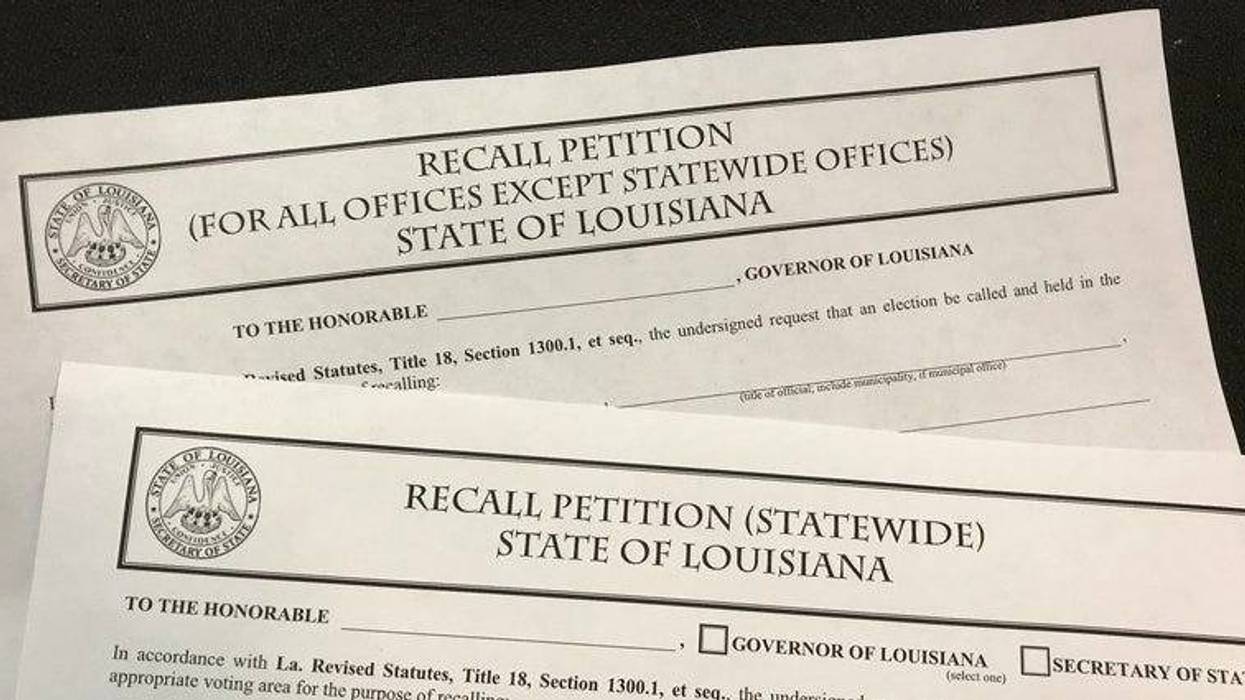

If you call the Orleans Parish Registrar of Voters Office and ask to view the signatures on the recall petition, you may meet some resistance.
We called the registrar's office this morning and requested to view those documents, which, under state law, are public documents. The employee we spoke to told us she didn't think we could. She also said that she'd have to check with a manager and that she would call us back.
An attorney we spoke to said the public absolutely has the right to view them.
"The Louisiana Constitution has a very clear, explicit guarantee of the right of the public to view all public records unless they are specifically exempted," Lori Mince, attorney with the Fishman Haygood, said. "You can only deny access to the public if there is some exemption, and here, I'm not aware of any exemption that would protect these records, and so I think they are public both under the Louisiana Constitution and under our public records law."
Article 12 Section 3 of the Louisiana Constitution reads as follows:
No person shall be denied the right to observe the deliberations of public bodies and examine public documents, except in cases established by law.
Louisiana Revised Statues 44:1 defines "public records" as follows:
All books, records, writings, accounts, letters and letter books, maps, drawings, photographs, cards, tapes, recordings, memoranda, and papers, and all copies, duplicates, photographs, including microfilm, or other reproductions thereof, or any other documentary materials, regardless of physical form or characteristics, including electronically stored information or information contained in databases or electronic data processing equipment, having been used, being in use, or prepared, possessed, or retained for use in the conduct, transaction, or performance of any business, transaction, work, duty, or function which was conducted, transacted, or performed by or under the authority of the constitution or laws of this state, or by or under the authority of any ordinance, regulation, mandate, or order of any public body or concerning the receipt or payment of any money received or paid by or under the authority of the constitution or the laws of this state, are "public records", except as otherwise provided in this Chapter or the Constitution of Louisiana.
Mince says once someone requests to view the petition, the registrar's office has three days to provide the documents or to give a reason why they can't be viewed. Mince added that anyone who requests to view the documents and is denied may sue the registrar to force her to make those records available for review.
"The party seeking the records can take the public body to court in what's called a mandamus proceeding," Mince said. "It's an expedited proceeding filed in the district courts in the state of Louisiana that says I want a determination in the next 10 days that I'm entitled to see these records. The court is obligated to set that for hearing within 10 days."
That, Mince says, could lead to a loss in time and money for the registrar's office.
"The public records law, though, does say that if the party seeking access to the records prevails, then the public body is to be ordered to pay their attorneys' fees," Mince said. "If a lawsuit were filed and the registrar of voters did not prevail and were ordered to produce the records, they would not only have to produce the records, they would also have to pay the plaintiff's legal fees."