

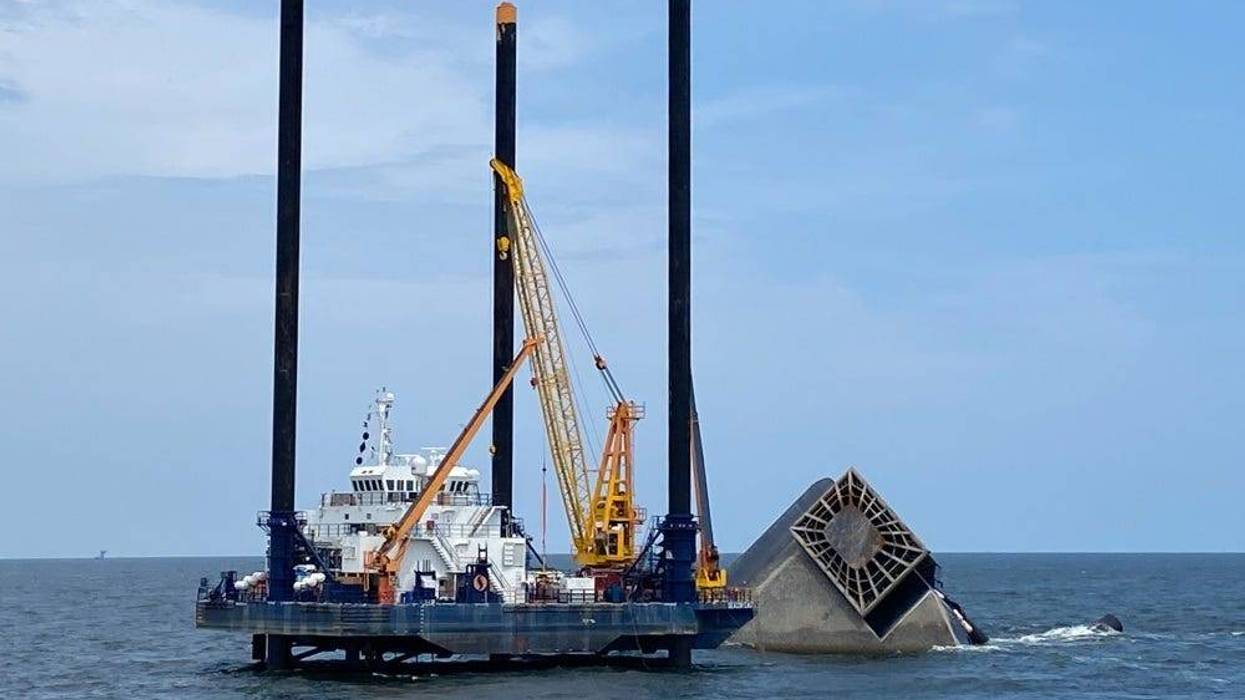

The salvage operation to refloat and move the capsized Seacor Power to a port where the investigation into its sinking is about to begin in earnest.
“Our main objective is to recover the Seacor Power in the safest manner possible while protecting the surrounding environment,” says Coast Guard Petty Officer Cory Mendenhall.
Salvage divers have completed their task of hot tapping the Seacor Power’s fuel tanks and removed more than 20,400 gallons of diesel fuel.
More than 4,500 gallons of hydraulic fluid remain aboard the ship in tanks that are not reachable by such means.
Now begins the work to lift the partially capsized lift vessel from the bottom.
“They’re going to do what’s called an inverted refloat operation,” Mendenhall says. “And that uses air pressurization and pumping. They are going to pump air into voids and tanks throughout the ship to create buoyancy.”
Mendenhall says air pumped into empty tanks and voids in the hull will make the Seacor Power buoyant. Then:
“They will refloat it in an inverted manner and that just basically means upside down, and that’s just due to its current position,” Mendenhall explains. “It’s a lot safer and more stable than trying to turn it over while it’s in the water.”
Enter Chesapeake 1000: Refloating the Seacor Power is just the beginning. Cory Mendenhall with the U.S. Coast Guard describes the next step in the recovery.
“Once it’s refloated and stabilized by tugs, this large crane is brought in, it’s called the Chesapeake 1000” Mendenhall says. “The ship will be lifted and a salvage barge will be positioned under the vessel once it’s refloated and there they will maneuver the vessel onto the barge deck.”
From there the Seacor Power will be secured to the deck of the barge and moved to port.
When the barge carrying the Seacor Power, devoid of lift legs which will be cut away in the refloating process, the National Transportation Safety Board will take over the investigation into the sinking.
“The NTSB, they’re lead on the investigation. So the plan is once the vessel is raised, it will be moved into port and that investigation will continue.”
The NTSB will commence an inspection of the ship, searching for the bodies of any missing crew members who might still be aboard.
Investigators will study the ship and its instruments to learn the state of the ship at the moment it suffered the catastrophic event which brought about its demise and the loss of its crew members.