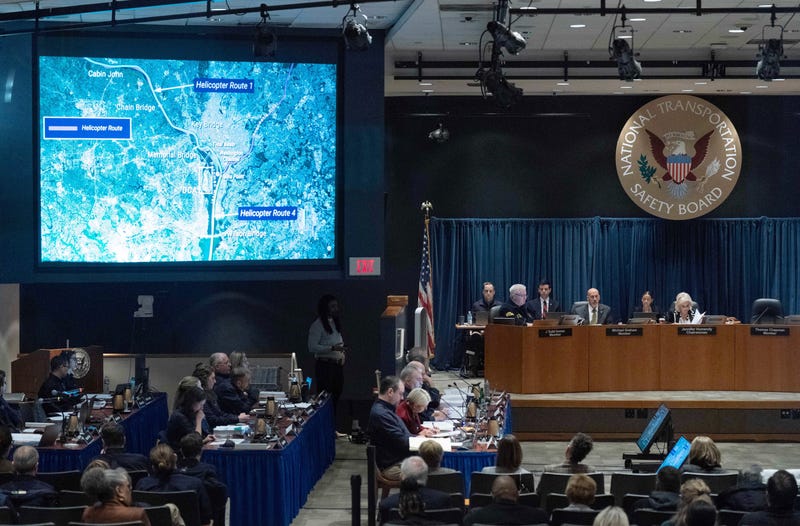
WASHINGTON (AP) — The air traffic controller who was managing numerous aircraft around Reagan National Airport felt a “little overwhelmed” just a few minutes before an American Airlines jet collided midair with an Army helicopter near Washington D.C., killing 67 people last year, an investigator said Tuesday at a National Transportation Safety Board hearing to determine the biggest factors in the crash.
Some key themes emerged: The jet’s pilot was not alerted about the helicopter; airspace in the nation's capital was crowded the night of Jan. 29, 2025; and warnings for years to reroute helicopter traffic were ignored.
NTSB members seemed deeply troubled over missed opportunities and worried that additional disasters may occur if the government doesn't act on the investigation findings.
“Are we going to sit here five years from now and say the data was there five years ago?” Todd Inman said, referring to staffing and training challenges at the airport. “We know people were raising the concerns, people were saying this was dangerous five, 10 years ago, and nobody was really listening.”
Systemic problems caused the crash
Before hearing from investigators, Inman said “systemic issues across multiple organizations,” not an error by any individual, caused the tragedy.
Everyone aboard the jet, flying from Wichita, Kansas, and the Black Hawk helicopter died when the two aircraft collided and plummeted into the icy Potomac River. It was the deadliest plane crash on U.S. soil since 2001, and the victims included 28 members of the figure skating community.
The Federal Aviation Administration last week made a permanent change to ensure helicopters and planes no longer share the same airspace around the airport. The NTSB will recommend additional action, and families of the victims say they hope there's meaningful change.
Missed warning signs
NTSB chairwoman Jennifer Homendy said she couldn’t believe the FAA didn’t realize the helicopter route in use during the crash didn’t provide adequate separation from planes landing on Reagan’s secondary runway. She noted that the FAA had refused to add detailed information about helicopter routes to pilots' charts so they could better understand the risks.
“We know over time concerns were raised repeatedly, went unheard, squashed — however you want to put it — stuck in red tape and bureaucracy of a very large organization,” Homendy said. “Repeated recommendations over the years.”
Overwhelmed controller
NTSB investigator Katherine Wilson said an air traffic controller felt a “little overwhelmed” when traffic volume increased to 10 aircraft about 10 to 15 minutes before the collision, but then “felt the volume was manageable when one or two helicopters left the airspace.”
Yet about 90 seconds before the collision, Wilson said, “traffic volume increased to a maximum of 12 aircraft consisting of seven airplanes and five helicopters. Radio communication showed that the local controller was shifting focus between airborne, ground and transiting aircraft.”
The workload “reduced his situational awareness,” Wilson said.
Details were difficult for families to hear
NTSB investigators showed a video animation to demonstrate how difficult it would have been for the pilots in both aircraft to spot the other amid the lights of Washington. The animation also showed how the windshields of both aircraft and the helicopter crew’s night vision goggles restricted views.
Family members in the room listened intently during the hearing. Earlier, some people were escorted from the room, including two in tears, as an animation of the flights began. Several entered the auditorium wearing black shirts bearing the names of crash victims.
Ahead of the hearing, Rachel Feres, who lost her cousin Peter Livingston and his wife and two young daughters, said she was hoping for “clarity and urgency” from the NTSB process.
“I hope that we see a clear path through the recommendations they offer to ensure that this never happens again,” Feres said. “That nobody else has to wake up to hear that an entire branch of their family tree is gone, or their wife is gone or the child is gone.”
The government will have to make changes
Whether that happens depends on how Congress, the Army and the Trump administration respond after the hearing. A pending bill would require all aircraft to have advanced locator systems to help avoid collisions.
Even before Tuesday, the NTSB had already spelled out many key factors that contributed to the crash. Investigators said controllers in the Reagan tower had been overly reliant on asking pilots to spot other aircraft and maintain visual separation.
The night of the crash, the controller approved the Black Hawk's request to do that twice. However, the investigation has shown that the helicopter pilots likely never spotted the American Airlines plane as the jet circled to land on the little-used secondary runway.
In a statement, the FAA said it has reduced hourly plane arrivals at Reagan airport from 36 to 30 and increased staff. The agency said it has 22 certified controllers in the tower and eight more in training.
“We will diligently consider any additional recommendations” from the NTSB, the FAA said.
Several high-profile crashes and close calls followed the D.C. collision, alarming the flying public. But NTSB statistics show that the total number of crashes last year was the lowest since the COVID-19 pandemic hit in 2020, with 1,405 nationwide.
___
Funk reported from Omaha, Nebraska, and White reported from Detroit.