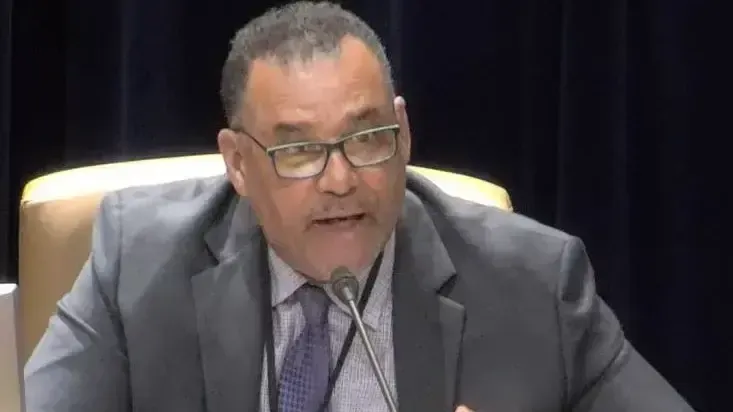


We’re 200 days away from electing our next mayor, and there are plenty of discussions to be had.
Yesterday I interviewed New Orleans City Councilman and mayoral candidate Oliver Thomas. Today, I interviewed another candidate and former Orleans Parish Criminal Court Judge, Arthur Hunter.
Toward the end of the interview, I asked Hunter about his stance on a more recent contentious political subject: how the city procures large contracts for services like trash collection. Hunter's response, I feel, summed up his unique position in the race.
Hunter said, “That's one of the reasons why we are where we are in New Orleans. It's based on who you know and not what you know. It's based on who you went to school with, who you grew up with, and who's in your political crew. I don't have a political crew, you know, I've been a police officer, I'm a lawyer, and I've been a judge…I don't have time for politics…We have too much politics and personality and not enough policy and fixing the problems and coming up with solutions.”
Hunter’s current view of the state of New Orleans
Now, just because you talk about being non-political doesn’t make it so, but there is something to note about his position as a judge, which is further removed from the political spotlight. Unlike two of the other top candidates, he’s not on the city council and bears far less of a responsibility for holding the Cantrell administration accountable for mismanaging the city over the past 7 years and counting.
But that's top level. What it comes down to is casting a convincing vision that intricately addresses the city's most pressing needs.

I asked Hunter how he would grade the city from F to A+, and he gave it a D+. Not a total failure, but certainly not a passing grade.
“Let me tell you why,” Hunter explained. “Especially the last four years, you have the city council fighting the mayor, and the mayor fighting the city council, and nothing's getting done. That's what we have…It's time to turn the page.”
Why Hunter believes his record supports mayoral hopes
“There’s finger-pointing drama and nothing's getting done,” Hunter says. “Look, when I was on the bench, I started programs that reduce crime, created jobs, improved education, provided treatment to people suffering from mental health and drug addiction, and created programs for kids.”
Hunter also explains how his experience with the NOPD relates to his mayoral aspirations, saying, “When I was a New Orleans police officer, I was assigned to the urban squad, which is the housing projects in the fifth district…And that those are the toughest parts to patrol in the city. And look, when you're in a one-man unit in the middle of the night…you don't have time for finger-pointing drama and kicking the can down the road. You have to make tough decisions and tough situations. That's where we are right now in New Orleans.”
Hunter’s strong stance on crime and approach to fixing city services
Managing crime remained a core pillar of Hunter’s drive to get elected. I asked Hunter if he agreed that the main priority needs to be the delivery of basic city services rather than investment in additional social services.
“I think we have to do both," Hunter replied. "If I flood-proof and paved every street in New Orleans, and you're still getting carjacked, that's a problem. So as the mayor, you have to do both. For me, when you talk about social services, I'm talking about doing those things to prevent and reduce crime, as well as enforcing the laws.”
As part of the solution to the city's issues, such as being $800 million short of completing road projects, Hunter emphasized the need for expert help.
Hunter states, “You also have to bring experts on board… What I did at criminal court, when we established the reentry court, and I was a veterans treatment court judge, and even a mental health court judge, we brought different people together. They brought resources to the table, and we used those resources to leverage to get other resources… look at the problem that we have, and solve their problems…in order to fix streets and provide those basic city services.”
Hunter defends his experience
Our discussion drifted into Hunter's experience and what he would say to listeners who look at his record and think, Have you ever run an organization anywhere near the size of the city?
“I was the Chief Judge at Criminal District Court," Hunter said. "I had to manage more than 100 people. But let me say this, fundamentally, (it takes) having the right people around you, giving them the resources that they need, the empowerment they need to do what they need to do, and holding them accountable.”
“You know what I had to do every morning?" Hunter continued. "I had to be concerned with the victims and the victim's family, the defendant and the defendant's family. NOPD, DA, defense attorneys, public defenders' office, sheriff's office, clerk's office, probation and parole, Department of Corrections. Along with colleagues and Appeals Court and Supreme Court and then outside of that, I had to deal with special interest groups, Metropolitan Crime Commission, Police and Justice Foundation, Court Lodge, and the media.”
What are New Orleans' 3 biggest challenges?
When asked what the three biggest problems he’d focus on as mayor, Hunter replied, “Crime, infrastructure, and business environment… I’m talking about creating an environment for businesses to succeed, which means making sure you can get that permit as soon as you can. Making sure we teach entrepreneurs how to be entrepreneurs and make sure they have access to capital. Those are the top three. And we also have to deal with NORDC, how to make NORDC work for all our children.
Addressing monetary needs
Arthur Hunter isn’t as name-recognized as a Helena Moreno or Oliver Thomas, and the burden is his to raise more money to spread his message to potential voters. I asked Hunter how much he thinks it'll take.
“One million dollars,” Hunter says. “Let me say this, though, I did not enter public service for the money. And I have never had money. But you know what I did have? People. The people I meet in the street, the people who know the kind of work I've done. I've always had the people. And let me tell you, the person with the most money doesn't always win. And, you know, go back to LaToya Cantrell and Desiree Charbonnet. Desiree Charbonnet had all the money. Cantrell became mayor. So it's not about money. It's about reaching people and letting those people know…I'm going to take care of our problem, because it's not just my city…it’s our city.”